And Started Becoming Part of the Business
A year and a half ago, I walked into a successful home-services company expecting to do what I had done many times before: understand the business, identify opportunities, offer advice, and help the owner make better decisions. Something different happened. I stayed.
Not literally every hour of every day, but enough that the line between consultant and operator began to disappear. I didn’t want to be the consultant who stopped by once a week or once a month, delivered some observations, collected a fee, and disappeared until the next meeting. If I was going to advise an entrepreneur about his business, I wanted to understand it. Really understand it. So I rolled up my sleeves.
Sometimes CFO. Sometimes COO. Sometimes Coach.
My role changed depending upon what the business needed. Some days I was effectively a fractional CFO, looking at margins, cash flow, compensation, pricing, projections, capital, and the economics behind important decisions. Other days I was closer to a fractional COO, working through scheduling, technology, inventory, sales processes, employees, field operations, accountability, and the countless details that determine whether a strategy actually works.
Sometimes I was the coach, and just as importantly, sometimes I was the one being coached. The owner had spent more than two decades learning a business that I couldn’t possibly understand simply by studying financial statements or sitting in a conference room. He knew things I didn’t know, and I knew things he didn’t know. That became the foundation of our relationship.
Two Different Kinds of Experience
He brought decades of institutional knowledge developed through hands-on experience. I brought decades of experience in finance, investment banking, business consulting, strategy, and organizational development. Neither perspective was inherently more valuable than the other. The opportunity was in combining them.
Together, we began taking knowledge that had accumulated in one entrepreneur’s head over more than twenty years and turning it into something the entire organization could use. Processes became documented, expectations became clearer, and institutional knowledge became operating procedures, employee handbooks, training materials, management systems, and eventually playbooks that future operators and franchisees could follow.
What had once been “This is how I do it” gradually became “This is how we do it.” That’s a profound transition in the life of a business, and one that creates opportunities far beyond simply improving daily operations.
Trust Isn’t Part of the Engagement Letter
Trust has to be earned, and over time, the owner began to understand how I thought and approached decisions. He recognized that I wasn’t there to tell him he was wrong. I was there to ask why. Why do we do things this way? What does the data tell us? What are we assuming? What happens if we’re wrong? Are we making this decision because the evidence supports it, or because we want it to be true?
Sometimes my thinking changed his decisions, and sometimes his experience changed mine. That last part matters. Good consulting should change the consultant, too.
We learned how to challenge each other without making disagreements personal. We learned when experience should outweigh theory and when the numbers were revealing something that experience hadn’t yet shown us. We developed a relationship in which both of us could speak candidly, question assumptions, and learn from one another without diminishing the other’s knowledge or accomplishments.
In the process, we both became better decision-makers. That’s when I began to understand what Cognitive Business Consulting could really become.
The Job Got Bigger
As trust grew, so did the conversations. We weren’t just talking about today’s operations anymore. We were talking about tomorrow’s company: growth, leadership, capital, technology, strategic relationships, new markets, organizational structure, succession, enterprise value, and eventually whether decades of knowledge and operating experience could become something other entrepreneurs could successfully reproduce.
I helped evaluate potential strategic partners, introduced others, encouraged certain relationships, and advised against some opportunities that looked attractive on the surface. We came to appreciate that not every opportunity is a good opportunity, not every source of capital is good capital, and not every potential partner should become a partner. Growth, after all, isn’t automatically progress.
Knowing what not to do became every bit as important as deciding what to do.
Eventually, the business entered a new stage of its development. And in many ways, so did I.
Then Something Interesting Happened
Other people in the industry began noticing. Not necessarily because they knew everything happening behind the scenes, but because they could see the direction the business was taking. That attention led to conversations with other entrepreneurs, and I began recognizing something particularly interesting: although they operated in the same general industry, they were at entirely different stages of their entrepreneurial journeys.
One entrepreneur had already built a successful organization and was expanding through franchising. He had moved well into what I describe as the Maintenance stage of business development. He didn’t need someone to teach him how to become an entrepreneur. He needed an experienced perspective to help take an established platform to another level, strengthen its systems, evaluate opportunities, and navigate the complexities of further expansion.
Another entrepreneur was at almost the opposite end of the journey. His longtime boss, mentor, and the owner of the company where he had built his career had passed away. Suddenly, he found himself contemplating something he hadn’t necessarily planned: starting a business of his own.
His questions weren’t about scaling or enterprise value. They were about possibility. Could he do it? Should he start independently or consider a franchise? What would it cost? How would he finance it? Who could help him? What risks would he be taking, and what might the opportunity eventually become?
Here were two entrepreneurs in the same industry, with very different experiences, facing entirely different challenges. Both could benefit from experienced advice, but neither needed the same kind of help.
That’s When the Five Stages Became Real to Me
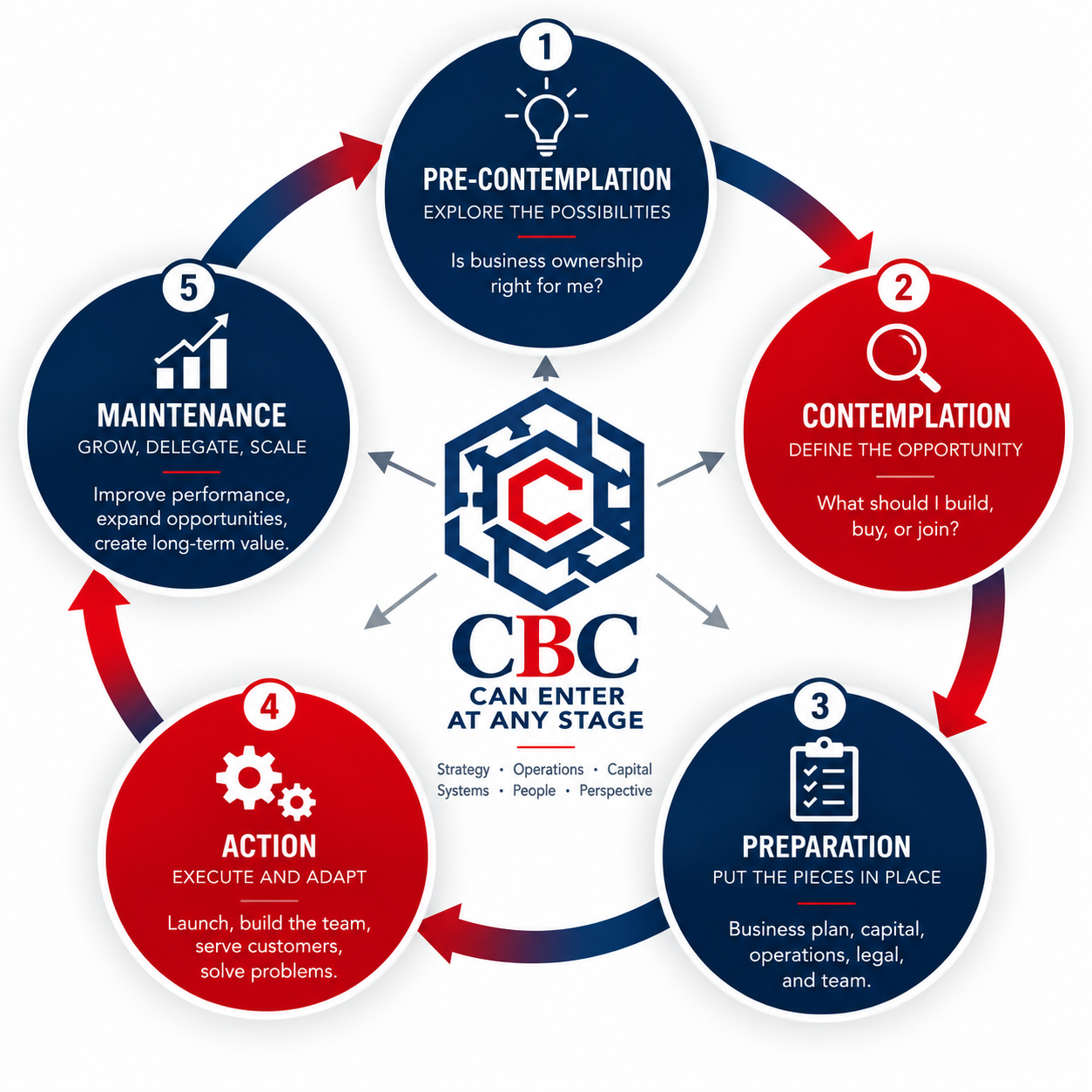
My training in cognitive behavioral coaching had introduced me to the principles of behavioral change, including the five-stage Stages of Change framework: Pre-Contemplation, Contemplation, Preparation, Action, and Maintenance. What fascinated me was how closely those stages could parallel the development of an entrepreneur and the evolution of a business.
In Pre-Contemplation, someone may not yet be seriously considering business ownership. During Contemplation, the possibility becomes real, and the entrepreneur begins evaluating options. Preparation involves committing to the opportunity and assembling the legal, financial, operational, and organizational pieces needed to begin. Action is where the business becomes real, bringing the daily challenges, victories, setbacks, and emotional demands of entrepreneurship. Maintenance is where the focus shifts toward sustainable growth, delegation, leadership development, stronger systems, expansion, and eventually succession or exit.
Of course, businesses don’t always move neatly through these stages, and experienced entrepreneurs may revisit earlier ones as new opportunities emerge. But the framework offers something valuable: a way to understand where an entrepreneur is today and anticipate the challenges likely to come next.
I realized that CBC doesn’t need to meet an entrepreneur at the beginning of the journey. We can enter wherever they are.
For one person, that may mean determining whether entrepreneurship is right for them. For another, it’s organizing the financial, legal, and operational requirements of launching a company. For someone already operating a business, it may mean navigating the emotional highs and lows without allowing every successful month or disappointing week to dictate strategy. For an established owner, it may involve developing leadership, accessing capital, evaluating acquisitions, franchising, or preparing for an eventual exit.
The stage changes, and so does our role. But the underlying principles remain remarkably consistent: clearer thinking, informed decisions, appropriate risk-taking, and disciplined execution.
This Is What Consulting Means to Me Now
I no longer believe the best consulting relationships exist solely across a conference table. I believe they develop when you’re willing to get close enough to a business to understand why things actually happen. Close enough to learn, close enough to challenge, close enough to occasionally be wrong, and close enough to earn the trust required to tell an entrepreneur something they may not want to hear.
I don’t want to replace an entrepreneur’s instincts. I want to help sharpen them. I don’t want to impose somebody else’s playbook on a business. I want to understand what makes that particular business successful and help build systems that allow its people to reproduce those successes consistently.
And I don’t believe an advisor should always have the answer. Sometimes our greatest contribution is recognizing which question needs to be asked next.
My experience over the past eighteen months reinforced something that decades in finance and business consulting had already taught me: the numbers matter, strategy matters, and systems matter. But the people making the decisions matter just as much. Understanding how they think, what motivates them, what they fear, and what they hope to accomplish is essential to helping their businesses succeed.
That’s the kind of consulting relationship that changed my own thinking, and it’s the kind I want Cognitive Business Consulting to build with others.
We Can Meet You Where You Are
Maybe you’re wondering whether you should start a business. Maybe you’re preparing to take the leap, or you’re already in the middle of building something. Perhaps you’ve created a successful company and are trying to figure out how to make it bigger without allowing it to consume your life. Or maybe you’re beginning to consider succession, a sale, or what comes after the business you’ve spent years building.
Wherever you are, the next stage will ask something different of you than the last one did.
Sometimes the best way to prepare isn’t another report, another seminar, or another consultant telling you what you’re doing wrong. Sometimes you need someone willing to roll up their sleeves, learn the business beside you, challenge your thinking, share what they’ve learned elsewhere, and be equally willing to learn something from you.
That’s Cognitive Business Consulting.
Better People. Better Systems. Better Businesses.
Where clearer thinking, smarter decisions, and disciplined execution create lasting value.